Background
One of the global challenges we faced is the AI development. Advancements in AI, particularly generative AI, have influenced various aspects of education, ranging from adaptive learning design and data-driven assessment to the development of dynamic curricula. However, these advancements also raise profound ethical and pedagogical questions: How can we ensure that AI serves as a tool to support and enhance the role of educators, rather than replace them? How can education continue to nurture human relationships and preserve the humanistic dimension of learning? How can education continue to nurture human relationships and uphold the humanistic dimension of learning? Amid the potential for dehumanization brought about by the dominance of technology, education must strive to maintain a balance between innovation and the core values of humanity and ecological sustainability.
In Indonesia, education reforms such as the Kurikulum Merdeka (Independent Curriculum) and the transformation of the National Assessment reflect a paradigm shift toward more autonomous, contextual, and problem-solving-oriented learning. These changes open up opportunities for integrating deep learning approaches, emphasizing conceptual understanding, reflective processes, and authentic learning experiences. One relevant approach within this framework is STEAM education (Science, Technology, Engineering, Arts, and Mathematics), which fosters interdisciplinary collaboration and creativity and strengthens scientific and technological literacy in real-life contexts. Nevertheless, significant challenges remain, including disparities in technological infrastructure across regions, limited pedagogical readiness among educators, and a widening digital divide between urban centers and underdeveloped, frontier, and outermost regions. Therefore, effective digital education transformation requires evidence-based strategies and approaches sensitive to social, cultural, and ecological contexts.
The Faculty of Teacher Training and Education (FKIP) at Sanata Dharma University, which has been committed to humanistic education since 1955, uses its 70th anniversary as a moment for critical reflection on the future of teacher education. Rooted in the philosophy of Prof. Dr. Nicolaus Drijarkara, SJ, the faculty embraces a vision of education as the formation of the whole person—intellectually sharp, socially aware, and ecologically committed. In this context, teacher education should cultivate critical digital literacy, ethical awareness in the use of technology, and transdisciplinary learning that nurtures a balanced development of cognitive, emotional, and ecological awareness.
As part of this celebration, the International Conference on Research in Education (ICRE) 2025 carries the theme “AI and the Future of Global Education: Harnessing Technology for Human Dignity and Ecological Sustainability.” The conference is an interdisciplinary academic forum encouraging critical exploration of how technology, reflective pedagogy, and humanistic values can be meaningfully integrated into global education systems. By bringing together scholars, practitioners, and policymakers worldwide, ICRE 2025 seeks to shape educational strategies that proactively respond to contemporary challenges while remaining grounded in human dignity and ecological sustainability
TIME AND VENUE
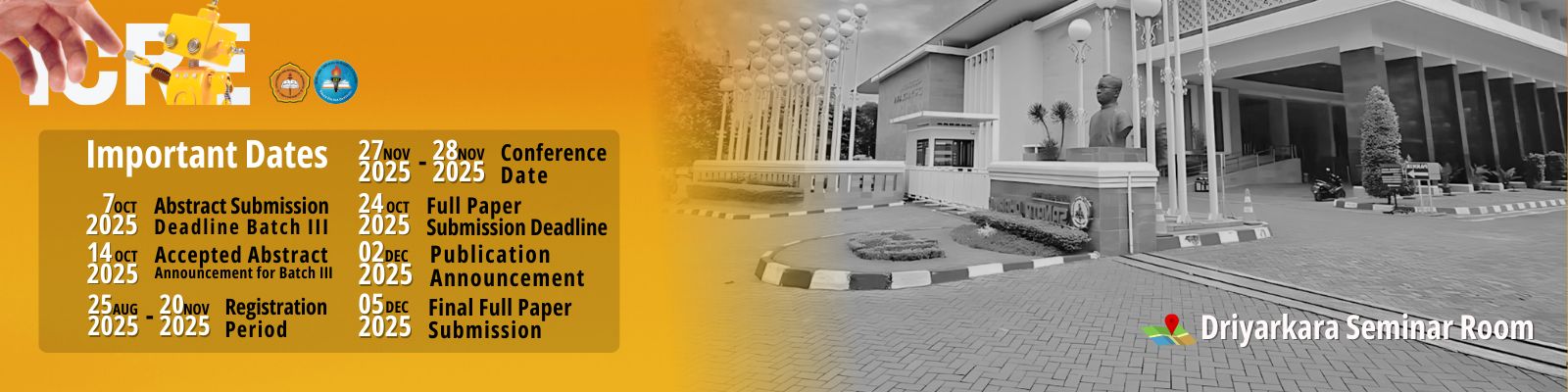
This conference will be held on:
Date : Thursday – Friday, 27 – 28 November 2025 – Add to your schedule
Venue : Ruang Seminar Auditorium Driyarkara USD Kampus II Mrican